

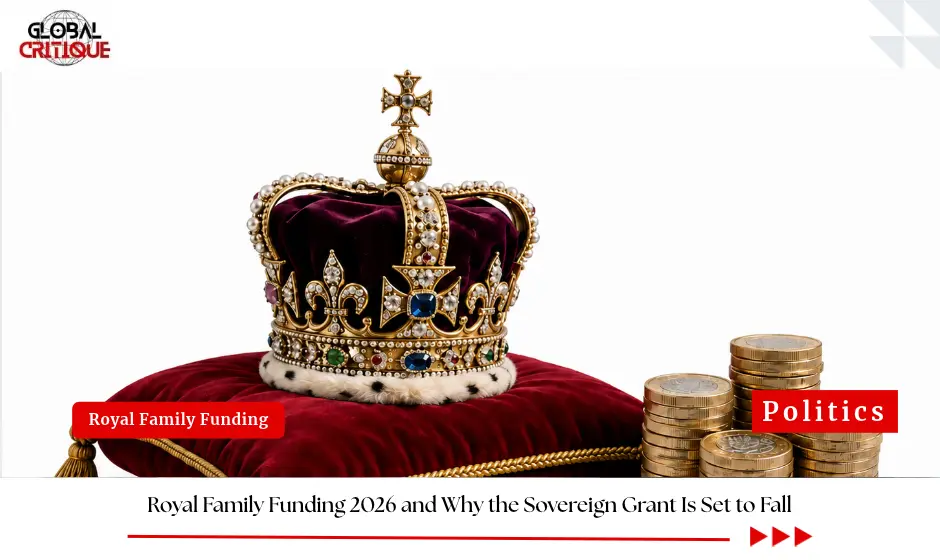
Royal Family funding is entering an important transition. The Sovereign Grant stands at £137.9 million for 2026 to 2027, but Parliament has approved legislation designed to reduce the figure to £99.9 million for 2027 to 2028. As of Parliament’s latest update on 15 October, the Sovereign Grant Bill had completed its stages in both Houses and was awaiting Royal Assent. That means the headline figure is expected to fall by £38 million. The reason is closely connected to the end of the decade-long Buckingham Palace Reservicing Programme, rather than a sudden withdrawal of support for the monarchy.
What the Sovereign Grant actually pays for
One of the biggest misunderstandings surrounding royal finances is the idea that the entire grant is personal income for the King.
It is not, the House of Commons Library explains that the Sovereign Grant supports the official functions of the monarchy.
It contributes to costs including
- Royal Household staff
- official travel
- maintenance of occupied royal palaces
- ceremonial and state functions
- administration connected with the monarch’s constitutional role
This distinction matters because public discussion often mixes institutional spending with the private wealth of individual members of the Royal Family.
They are not the same thing.
Why funding reached £137.9 million
The current level of the grant is unusually high partly because Buckingham Palace has been undergoing major infrastructure work. The Reservicing Programme has involved upgrading systems such as electrical wiring, heating, plumbing and other building infrastructure. This project created an additional funding requirement over several years.
As the programme approaches completion, the Government and Royal Trustees have concluded that the temporary higher level of funding should no longer continue in the same form. That is why the proposed £99.9 million figure matters. It represents a reset after a period of unusually high capital spending.
How much is the grant expected to fall
The numbers make the scale of the change easier to understand.
- Current 2026 to 2027 grant is £137.9 million
- Proposed 2027 to 2028 grant is £99.9 million
- Cash reduction is £38 million
- Parliament has also approved changes to how future grants can be adjusted
The House of Commons Library says the legislation would establish £99.9 million for 2027 to 2028 and introduce a new reference percentage of 20.5 per cent of Crown Estate income account net surplus for future calculations. The change is therefore not simply about cutting one year’s budget. It also changes the machinery behind future royal funding.
Why Parliament is changing the funding rules
The existing Sovereign Grant framework was designed to provide stability. One consequence is that reducing the grant from one year to the next can be difficult. The new legislation is intended to make the system more flexible. According to the House of Commons Library, it would allow future grants to fall when circumstances justify a lower level and would also give the Treasury limited powers to respond to exceptional circumstances.
That creates two different forms of flexibility
- Funding can be reduced when spending needs fall
- Additional funding can be considered when exceptional circumstances arise
This is one of the most important parts of the reform because it changes how future royal budgets can respond to changing circumstances.
Does the Crown Estate pay the King directly?
No, This is another area where public discussion often becomes confusing. The Crown Estate manages a large commercial property and land portfolio. Its profits go to the UK Treasury rather than directly to King Charles. The Sovereign Grant is calculated through a statutory mechanism linked to Crown Estate profits, but the money is then provided by the Government for official royal functions. That difference is important. Crown Estate profit and personal royal income are not interchangeable terms.
What happens to the £99.9 million figure after 2027
The current expectation is that £99.9 million will remain the benchmark for several years. During the House of Lords debate, Treasury minister Lord Pitt-Watson said the Government anticipated the amount remaining at that level for the next five years. That does not mean the amount can never change. The new framework includes provisions for future adjustments, particularly if circumstances change significantly.
What it does mean is that the Government is trying to move away from the temporary funding increase associated with the Buckingham Palace project.
Is the monarchy becoming cheaper?
The answer depends on what comparison is being made. In cash terms, the planned fall from £137.9 million to £99.9 million is substantial. However, the House of Commons Library notes that £99.9 million would still be around 65 per cent higher in real terms than the grant in 2016 to 2017, before the Buckingham Palace Reservicing Programme began. That provides useful context.
Two statements can therefore be true at the same time
- Royal funding is expected to fall sharply from its current level
- The proposed amount remains higher in real terms than before the palace refurbishment programme
This is the kind of context that is often missing from simple headlines about the cost of the monarchy.
Does the Sovereign Grant fund Harry and Meghan
No., Harry and Meghan remain outside the working monarchy despite their Sussexes UK return. Their move back to Britain does not mean their private home, commercial activities or independent charitable work are being funded through the Sovereign Grant. Reuters reported that the couple would not resume official royal duties following their return. The Sovereign Grant is intended to support official royal functions. That distinction becomes especially important when public discussion combines royal family members with institutional monarchy spending.
What taxpayers are actually paying for
A useful way to understand the debate is to separate three different financial categories.
Official monarchy spending
This includes the Sovereign Grant and costs related to official duties.
Duchy income
The King and Prince of Wales receive income connected with the Duchies of Lancaster and Cornwall.
Private wealth
Members of the Royal Family also have personal assets, investments and inherited wealth. These categories are often discussed together, but they operate differently. A headline claiming that taxpayers pay for every aspect of royal life can therefore be misleading unless it explains which type of funding is being discussed.
Why this change matters beyond the headline number
The most important part of the current funding story is not simply that the number is falling. It is that Parliament is changing the framework. The new system is intended to allow royal funding to move down as well as up, depending on spending requirements. That creates a more adaptable model than the previous arrangement and makes future comparisons easier because temporary Buckingham Palace costs will no longer dominate the headline figure. The current debate around Royal Family funding in 2026 is therefore not just about how much the monarchy costs today. It is about what taxpayers will fund after one of the largest royal property programmes in decades comes to an end.