

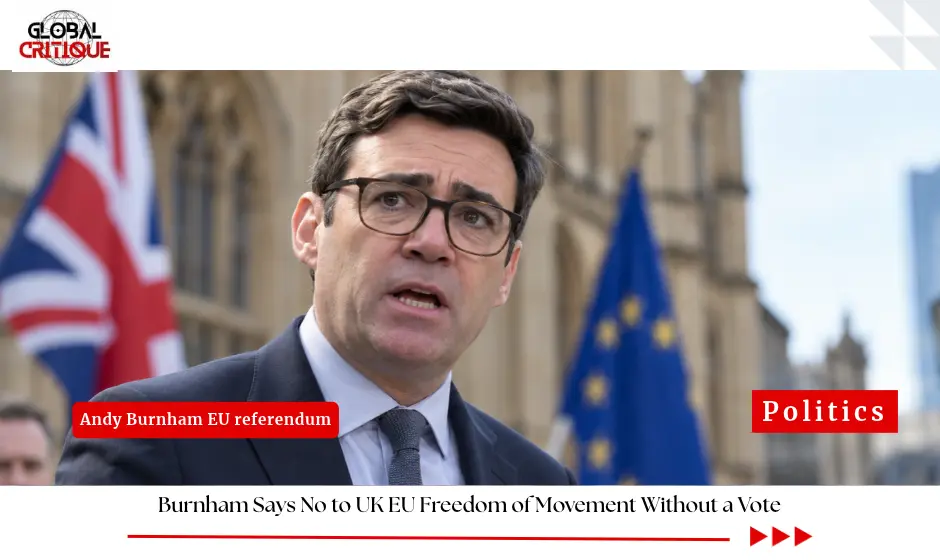
Prime Minister Andy Burnham has said UK EU freedom of movement should not return without public approval, following questions about a possible referendum on 26 October 2026. However, Downing Street later clarified that no formal decision had been made on whether a referendum would be required.
Burnham has maintained Labour’s existing Brexit commitments during the current Parliament. At the UK-EU summit in Brussels on 20 November, Britain and the European Union reached new arrangements covering youth mobility, food trade and carbon markets. However, these agreements do not restore unrestricted freedom of movement or announce a referendum on Britain’s relationship with the EU.
The remarks followed Burnham’s call for an open discussion about Britain’s relationship with Europe, almost a decade after the 2016 Brexit referendum.
His comments have renewed questions about the balance between public consent, immigration control and the economic benefits of closer cooperation. But there is a considerable difference between discussing future possibilities and announcing a policy that changes people’s rights.
Key Takeaways From Burnham’s EU Freedom of Movement Comments
- Andy Burnham said on 26 October 2026 that he would not restore EU freedom of movement without public approval.
- Downing Street subsequently clarified that the government had not decided whether any future agreement would require a referendum.
- The government continues to rule out returning to the EU single market, customs union or freedom of movement during the current Parliament.
- No referendum date, negotiating mandate for full free movement or agreement to rejoin the EU has been announced.
- The UK and EU reached agreements on youth mobility, food trade and carbon market cooperation at the Brussels summit on 20 November 2026. None of these agreements restores unrestricted freedom of movement.
- The agreed Youth Experience Scheme is intended for people aged 18 to 31, offering stays of up to three years. It will be capped, time-limited and visa-based, rather than providing permanent freedom of movement.
- Official data show UK net migration fell to an estimated 171,000 in the year ending December 2025.
- Any future change in British or EU citizens’ rights would depend on negotiations and the necessary legal decisions.
- On 27 October, Business Secretary Jonathan Reynolds discussed longer-term UK-EU options while stressing that the forthcoming November summit would focus on practical agreements.
- On 3 November 2026, reports confirmed that the UK and EU had agreed draft terms to reduce checks on food and agricultural trade. The proposal does not restore unrestricted freedom of movement.
- On 5 November 2026, former EU Brexit negotiator Michel Barnier said future full participation in the single market would require accepting freedom of movement.
- On 6 November, Bank of England governor Andrew Bailey said more open trade with European neighbours could support UK economic growth, while UK-EU negotiations over student tuition fees remained unresolved.
- On 8 November, Culture Secretary Lisa Nandy defended the return of Erasmus+ in 2027 while cautioning against reopening the debate over EU membership.
- On 9 November, Norwegian Prime Minister Jonas Gahr Støre warned that a Norway-style single market arrangement would require Britain to accept significant EU rules without full EU membership.
What Did Andy Burnham Say About a New EU Referendum?
Why Burnham Linked Freedom of Movement to Public Consent
The debate intensified after Burnham discussed the possibility of restoring closer links with the European Union during interviews over the weekend of 24 and 25 October.
He suggested that Britain needed a more informed discussion about the advantages and disadvantages of its post-Brexit arrangements. His argument centred on how patterns of migration and cooperation between European countries have changed.
On 26 October, journalists asked whether his government could return to EU freedom of movement without holding a referendum. Burnham answered no and emphasised that he would not move further on Brexit than the British public was prepared to accept.
The Prime Minister’s remarks on freedom of movement initially appeared to establish a clear commitment to another public vote.
Yet Downing Street later clarified that no decision had been made on whether a referendum or a future general election would provide public approval for any significant change.
This clarification matters. The Andy Burnham EU referendum debate concerns how the public might approve a possible future change. It does not mean the government has formally scheduled a national vote.
Why Labour’s Existing Brexit Commitments Still Apply
Burnham has also said that his administration will not abandon the commitments made in Labour’s 2024 general election manifesto during this Parliament.
Those commitments ruled out restoring freedom of movement or returning to the EU single market and customs union.
A parliamentary answer published on 23 October 2026 confirmed that the government’s existing restrictions remain in place, while allowing discussion of longer-term options.
The distinction leaves room for political debate without creating an immediate change in law.
Why Has the UK-EU Freedom of Movement Debate Returned?
How Immigration Changed After Brexit
The UK formally left the European Union on 31 January 2020, while the Brexit transition period ended on 31 December that year.
The end of free movement changed how many EU citizens could come to Britain for employment or long-term residence. It also changed the rights of most British citizens seeking to live and work in EU countries.
Instead of relying on automatic EU free movement rights, most new arrivals must meet the immigration requirements that apply to their nationality and circumstances.
These Brexit immigration rules did not stop international migration. They changed the routes through which people could enter the country and the conditions attached to their stay.
Britain subsequently experienced a substantial rise in non-EU migration, followed by a sharp fall in recent estimates.
That shift has become part of the broader discussion about whether the current system provides the right balance between economic needs, migration management and opportunities for British citizens abroad.
Why Burnham Wants a Wider European Discussion
Burnham argues that previous arrangements allowed more temporary or circular movement between European countries, with some people travelling for work before returning home.
He has suggested that stronger cooperation with EU governments could also improve the management of irregular migration.
These arguments are political assessments rather than proof that restoring free movement would automatically resolve the UK’s immigration challenges.
The wider conversation about UK-EU relations after Brexit therefore extends beyond the question of who can enter Britain.
It also concerns trade barriers, access to employment, cooperation between governments and the rights British nationals previously exercised within Europe.
Would Restoring EU Freedom of Movement Legally Require a Referendum?
The Difference Between a Political Pledge and a Legal Requirement
A referendum pledge is not the same thing as an existing legal requirement.
The United Kingdom does not have a general constitutional rule requiring a referendum before every major agreement with the European Union.
National referendums are normally authorised through legislation passed by Parliament. That legislation establishes the question, voting arrangements and legal framework.
The parliamentary explanation of UK referendums confirms that holding a national referendum requires primary legislation.
Consequently, the Andy Burnham EU referendum discussion involves two separate questions.
- Whether ministers would decide that a future freedom of movement agreement should receive public approval through a referendum.
- Whether Parliament would pass the legislation needed to conduct that vote.
Neither a referendum requirement nor a timetable for such a vote had been formally announced as of 20 November 2026.
Could a General Election Provide a Mandate?
A government may seek public support for policy changes through a general election manifesto.
That is different from a referendum, which asks voters to decide a specific question directly.
Both approaches can influence political decision-making, but they have different constitutional and practical consequences.
Downing Street has not confirmed which route, if any, would be proposed for a substantial change in Britain’s European relationship.
The absence of that decision means readers should not interpret Burnham’s remarks as a binding announcement of another Brexit referendum.
What Would Full EU Rejoining Require?
Rejoining the European Union would be a separate and more extensive process than negotiating a limited mobility agreement.
Under Article 49 of the Treaty on European Union, an applicant country must complete an accession process involving the EU institutions and member states.
The process requires unanimous agreement in the Council, consent from the European Parliament and ratification of the accession agreement under the applicable constitutional requirements.
Therefore, even a successful UK referendum would not automatically restore EU membership.
The EU’s legal framework for membership applications makes clear that accession involves an international agreement, not simply a domestic political decision.
This is why discussions about UK single market membership, partial mobility agreements and full EU membership must be treated as different policy options.
What Would UK EU Freedom of Movement Mean for Ordinary People?
Rights for British Citizens Working or Living in Europe
Before Brexit ended general free movement rights between the UK and EU, British citizens enjoyed broad opportunities to move, live and work across the bloc under EU law.
Today, a British citizen who wants to take a permanent job in an EU country will normally need to follow that country’s immigration and employment requirements, unless an existing agreement or personal status provides another route.
Short visits remain possible under separate travel arrangements. For the Schengen area, many British visitors can stay for up to 90 days in any rolling 180-day period without a visa, provided they meet the relevant conditions.
However, permission to visit is not the same as permission to take employment or settle permanently.
If broad reciprocal mobility rights were ever restored, British workers and their families might gain easier access to employment and residence opportunities.
The exact benefits would depend on the terms agreed by both sides.
What Could Change for EU Citizens Moving to Britain?
EU nationals who wish to move to the UK for work generally face a different system from the one that applied before the end of the Brexit transition period.
Some people continue to hold protected rights through the EU Settlement Scheme or other arrangements.
For most new applicants, however, permission depends on the relevant visa or immigration category.
A new reciprocal agreement could potentially simplify some aspects of employment and residence.
It would not necessarily recreate every previous right automatically.
For this reason, anyone making plans under the current Brexit immigration rules should continue using the existing official requirements until a new agreement has been formally implemented.
Why the Youth Experience Scheme Is Different
The Youth Experience Scheme agreed by the UK and EU on 20 November 2026 will create temporary opportunities for eligible young people without restoring full freedom of movement.
The scheme will cover people aged 18 to 31 and allow stays of up to three years for activities including work, study and travel. It will be reciprocal, providing opportunities for British citizens in participating EU countries and eligible EU citizens in Britain.
The UK government has confirmed that the arrangement will be capped, time-limited and visa-based. Participants will not have access to benefits or an automatic right to bring dependants.
Unlike unrestricted freedom of movement, the scheme will operate under specific eligibility and immigration conditions. Further application procedures and implementation arrangements will need to be confirmed before eligible individuals can apply.
The distinction remains central to Burnham’s wider Brexit position. Limited opportunities for young people do not amount to restoring the general right for British and EU citizens to settle and work across each other’s territories.
| Arrangement | What it means for individuals |
| Current post-Brexit rules | Immigration permission depends on nationality, destination and activity |
| Agreed Youth Experience Scheme | Temporary, capped, visa-based opportunities for eligible people aged 18 to 31 |
| Full reciprocal freedom of movement | Broader rights to live and work under an agreed legal framework |
The UK government’s 20 November announcement outlines the agreed Youth Experience Scheme, while the final application procedures and implementation timetable remain subject to further arrangements.
How Would Closer UK-EU Relations Differ From Rejoining the EU?
Can Britain Make New Trade Agreements Without Free Movement?
Yes. The UK and EU can negotiate cooperation in specific areas without restoring unrestricted movement of people.
For example, agreements covering food standards, electricity trading or emissions systems may reduce particular barriers while leaving broader immigration arrangements unchanged.
Such deals still involve negotiations, responsibilities and approval processes.
They do not necessarily require Britain to rejoin the European Union or accept every obligation of its single market.
This distinction is central to understanding UK-EU relations after Brexit.
A practical agreement that helps food exporters is a different proposition from restoring comprehensive residency and employment rights.
Single Market Membership, Customs Union and EU Membership
The terms are sometimes used together in political debate, although they describe different arrangements.
UK single market membership would involve participation in a system designed to facilitate the movement of goods, services, capital and people. Comprehensive participation generally carries free movement obligations.
A customs union mainly concerns customs duties and trade arrangements for goods. It does not automatically create unrestricted rights for people to live and work across borders.
Full EU membership would involve a much wider legal and institutional relationship, including participation in the Union’s political structures and obligations.
Each option presents different questions for Parliament, businesses, workers and the public.
The House of Commons Library briefing on UK-EU membership provides additional context for these distinctions.
What Michel Barnier Said About Rejoining the EU
On 5 November 2026, former EU Brexit negotiator Michel Barnier told Sky News that Britain would have to accept freedom of movement if it sought to rejoin the EU single market.
He said the single market’s four freedoms covering goods, services, capital and people remain linked. His comments underline the difference between negotiating limited trade cooperation and pursuing full participation in the single market.
Barnier also suggested that a future UK membership negotiation could explore arrangements concerning the euro. However, existing EU accession rules generally require new member states to commit to adopting the single currency when the necessary conditions are met.
His remarks should not be interpreted as a formal EU offer of a currency exemption or a change in British government policy.
The government has not announced plans to restore unrestricted freedom of movement during the current Parliament.
Norway PM Warns Against a UK-EU Single Market Deal
Norwegian Prime Minister Jonas Gahr Støre warned Britain against copying Norway’s relationship with the European Union during an interview reported on 9 November 2026.
Støre explained that Norway participates in the European Economic Area, giving it access to the EU single market without being an EU member. However, the arrangement also requires Norway to implement many EU rules without having a vote in the EU institutions that adopt them.
His comments are relevant to Prime Minister Andy Burnham’s discussion about Britain’s future relationship with Europe. Norway’s model includes the free movement of people alongside the movement of goods, services and capital.
For the UK, such an arrangement would involve significantly broader obligations than the limited trade and youth mobility agreements announced at the 20 November summit.
The warning does not mean Britain has proposed joining the European Economic Area. The government has not announced such a decision, and its existing Brexit commitments remain in place.
Why British Businesses Are Following the Debate
Companies trading with European customers are interested in more than migration rules.
Food producers, for example, may face administrative requirements when exporting products across borders.
A negotiated agreement covering agricultural and food standards could reduce some of those costs.
Manufacturers and service providers may also be interested in regulatory cooperation and opportunities for workers to move between countries.
However, easier trade does not automatically produce lower prices or higher economic growth. The outcome depends on the agreement’s scope, implementation and market conditions.
Investors also assess Britain’s broader economic outlook. Recent sterling movements against the euro show how currency markets respond to multiple economic and political factors, although those movements should not be attributed directly to Burnham’s comments without evidence.
Andrew Bailey Says Closer UK-EU Trade Could Support Growth
On 6 November 2026, Bank of England governor Andrew Bailey said Britain could benefit economically from trading more openly with its European neighbours.
Speaking to the BBC, Bailey distinguished the economic benefits of greater market openness from taking a political position on Brexit or whether Britain should rejoin the European Union.
His comments provide a broader economic context for the government’s discussions with Brussels ahead of the 20 November summit.
Reduced trade barriers could improve opportunities for some British businesses, although the scale of any benefit would depend on the agreements reached and how they are implemented.
Bailey’s remarks do not represent an endorsement of restoring unrestricted freedom of movement or a change in the Bank of England’s institutional position on EU membership.
What Did the November UK-EU Summit Change for Freedom of Movement?
What Britain and the EU Agreed in Brussels
Prime Minister Andy Burnham met European Council President António Costa and European Commission President Ursula von der Leyen at the second UK-EU summit in Brussels on 20 November 2026.
The two sides agreed new cooperation covering food trade, emissions trading, youth mobility, migration and security.
For the freedom of movement debate, the most important development is the limited Youth Experience Scheme. It creates a route for temporary mobility without restoring the broader rights British and EU citizens enjoyed before Brexit.
The summit therefore advanced practical cooperation but did not change Labour’s existing position on full freedom of movement or establish a referendum timetable.
For a detailed breakdown of the agreements on food trade, carbon markets and youth mobility, read our report on the UK EU Brexit reset deal, including the expected implementation dates and unresolved student tuition fee negotiations.
Food Trade, Migration and Youth Mobility
The Brussels summit produced agreements on food and agricultural trade, linked carbon markets and a reciprocal Youth Experience Scheme. Both sides also committed to closer migration and security cooperation. These measures are distinct from full EU membership and unrestricted freedom of movement, which remain outside the government’s current policy commitments.
The EU has also confirmed work on specific agreements covering agricultural products, electricity and related economic arrangements.
The agreements announced on 20 November establish a framework for closer cooperation in selected sectors, while their practical effects will depend on implementation. They do not change Britain’s status outside the European Union.
UK-EU Draft Food Trade Agreement Takes Shape on 3 November
The UK and European Union agreed draft terms for a new food and agricultural trade agreement on 3 November 2026, marking further progress ahead of the UK-EU summit scheduled for 20 November in Brussels.
According to ITV News reporting on 3 November, the proposed sanitary and phytosanitary (SPS) agreement would remove several post-Brexit checks and administrative costs affecting businesses trading food, plants and animal products.
The draft measures include removing certain export health certificates, phytosanitary certificates, inspection fees and other paperwork requirements. British agricultural exporters could benefit from easier access to European markets if the agreement is formally approved and implemented.
The UK government estimates that the agreement could eventually deliver £5.1 billion in annual economic benefits. However, this is a projected benefit, not a confirmed economic outcome, and the new trading arrangements are not yet in force.
The development matters to the wider UK-EU freedom of movement debate because it shows how Britain and the European Union can pursue sector-specific trade cooperation without restoring unrestricted rights to live and work across borders.
The proposed agreement remains subject to the necessary political, legal and implementation steps. It does not amount to Britain rejoining the EU single market or restoring freedom of movement.
The negotiations advanced at the Brussels summit on 20 November, when both sides agreed to proceed with arrangements designed to reduce food and agricultural trade barriers. The agreement still requires implementation and does not alter the immigration rights of British or EU citizens.
EU Electricity Market Talks Face New Financial Demands
Another issue emerged in UK-EU negotiations on November 10, 2026, when five European governments called for Britain to make financial contributions in exchange for closer integration with the EU electricity market.
Belgium, Germany, Denmark, Luxembourg and the Netherlands want any agreement on electricity market access to include contributions supporting economic and social development within the European Union.
According to Euronews reporting published on November 10, the proposal added a negotiating challenge in the period leading up to the 20 November summit.
However, the UK government has not agreed to the proposed financial contributions. Discussions remain ongoing, and the amount or final conditions of any payment have not been settled.
The development illustrates how closer UK-EU economic cooperation can involve new financial obligations. It does not represent an agreement to restore freedom of movement or rejoin the European Union.
EU Student Tuition Fees Dispute Remains Unresolved
Reporting published on 5 November indicated that several EU member states want stronger British commitments on tuition fees for European students.
Since Brexit, many EU students have faced international tuition fees at British universities rather than the lower rates available to eligible domestic students.
Some European governments want more favourable arrangements as part of the wider UK-EU reset, which also covers food trade, youth mobility and other areas of cooperation.
The dispute could complicate negotiations, but it has not resulted in a final agreement on tuition fees.
Any future concession would require further negotiations and should not be confused with restoring unrestricted freedom of movement.
The dispute remained unresolved after the 20 November summit. The UK and EU agreed to pursue a further agreement on student tuition fees, with the aim of concluding negotiations within six months.
The disagreement concerns the fees students from either side should pay when attending universities across the UK-EU border. No new reduced tuition rate was established by the summit announcement.
The issue is separate from unrestricted freedom of movement and should not be interpreted as an agreement to restore previous immigration rights.
Lisa Nandy Defends Erasmus+ and Closer UK-EU Cooperation
Culture Secretary Lisa Nandy defended the government’s approach to European cooperation on 8 November 2026 after criticism of remarks connecting the Erasmus+ student exchange programme with Remembrance Sunday.
Conservative Party chairman Kevin Hollinrake argued that the government’s announcement had inappropriately linked the occasion to its European policy. Nandy rejected that criticism and said educational exchanges could help younger generations understand Britain’s historical connections with European allies.
The UK and EU had already finalised arrangements in April 2026 for Britain to rejoin Erasmus+ in 2027. The programme is intended to give students, apprentices and other participants opportunities to study, train and gain experience abroad.
Nandy also cautioned against reopening the debate over whether Britain should rejoin the EU, while supporting closer cooperation and a clearer discussion of the country’s economic choices.
Erasmus+ participation does not restore unrestricted UK-EU freedom of movement. It is a specific education and training programme, separate from the proposed youth experience scheme and any future agreement on broader immigration rights.
Why the Summit Does Not Mean Free Movement Is Returning
The UK-EU summit on 20 November did not restore unrestricted freedom of movement between Britain and the European Union.
Although the two sides reached an agreement on temporary youth mobility, the scheme will operate within defined age limits, visa requirements and other conditions.
British and EU citizens do not automatically regain the broad rights to live and work across each other’s territories that existed before Brexit.
Burnham’s earlier comments about public approval therefore remain relevant to any future proposal for broader freedom of movement. The summit did not announce such a proposal or establish a referendum timetable.
What Jonathan Reynolds Said About UK-EU Relations on 27 October
Business Secretary Jonathan Reynolds provided further clarification on 27 October 2026 about the government’s discussions with the European Union.
Speaking ahead of the 20 November summit in Brussels, Reynolds said officials were considering the longer-term direction of Britain’s relationship with the bloc.
However, he stressed that the immediate focus remained on practical agreements intended to reduce trade barriers and improve cooperation.
Those priorities include food and drink trade, emissions trading and a proposed youth mobility arrangement.
Reynolds also acknowledged that uncertainty about future EU rules was affecting British businesses. Manufacturers face questions about changes to European procurement policies, subsidy arrangements and trading requirements.
Reynolds’ remarks formed part of the wider political debate ahead of the November summit. The agreements announced on 20 November focused on practical cooperation rather than restoring unrestricted freedom of movement.
The discussion could include future options involving closer economic cooperation and movement between countries, but no agreement to restore unrestricted freedom of movement has been announced.
However, Downing Street separately clarified on 27 October that current UK-EU negotiations were limited to the areas already agreed for the November summit. Officials said the talks did not involve reopening negotiations on freedom of movement and would remain within Labour’s existing manifesto commitments.
According to Sky News reporting on 27 October, the clarification followed questions about whether Reynolds’ comments signalled a change in the government’s position.
According to The Guardian’s reporting on 27 October, Reynolds said the public would ultimately determine which longer-term arrangements Britain accepts. He did not establish whether that would require a general election mandate or a referendum.
The distinction matters because exploratory discussions do not change the immigration rules currently applying to British or EU citizens.
What Do Migration Figures Reveal About the Post-Brexit Debate?
The Latest Available Official Figures
Official figures add useful context to the political argument.
The Office for National Statistics estimated long-term UK net migration at 171,000 in the year ending December 2025, compared with a revised 331,000 in the preceding year.
Net migration measures the difference between people arriving to live in a country for at least 12 months and those leaving for at least 12 months.
The provisional data also show considerable differences between nationality groups.
| Migration measure | Year ending December 2025 |
| Total UK net migration | 171,000 |
| Previous year’s revised total | 331,000 |
| Non-EU+ nationals | 350,000 |
| EU+ nationals | -42,000 |
| British nationals | -136,000 |
The negative figures mean that more people in those nationality groups left the UK for long-term residence abroad than arrived.
The figures are provisional estimates and rounded values. They should not be treated as exact counts of every individual border movement.
According to the official UK migration estimates, falling arrivals among non-EU+ nationals for work-related reasons were a major factor behind the overall decline.
What the Statistics Cannot Tell Us
These figures show a change in migration patterns. They do not establish whether voters support restoring free movement.
They also do not measure irregular Channel crossings, asylum applications or visitor arrivals in the same way.
The Brexit immigration rules debate therefore needs more than a single headline figure.
Any assessment should consider the reasons people migrate, the duration of their stay, labour market needs and the rights of both incoming and outgoing citizens.
Evidence can clarify the debate without resolving every political disagreement.
How Are Political Parties Responding to Burnham’s Brexit Position?
Labour’s Internal Debate
The Andy Burnham EU referendum discussion has brought different views within Labour into focus.
Some senior party figures support reviewing whether closer European cooperation could deliver economic benefits.
Angela Rayner has backed a pragmatic discussion about the available options. At the same time, other Labour representatives have emphasised the need to consider employment, migration and the political commitments made at previous elections.
Not every Labour politician supports the same degree of European integration.
Downing Street has therefore continued to distinguish Burnham’s longer-term personal views from the government’s immediate policy.
Conservative, Reform UK and Liberal Democrat Responses
Conservative leader Kemi Badenoch and Reform UK leader Nigel Farage have criticised reopening the debate about EU free movement.
Their objections focus on immigration control, the significance of the 2016 referendum result and whether closer European integration would weaken existing Brexit commitments.
The Liberal Democrats have argued that Labour should reconsider the restrictions it has placed on negotiations with the EU.
On 25 October, Liberal Democrat Home Affairs spokesperson Max Wilkinson called for a more open approach to European cooperation, including discussion of migration arrangements.
These positions reflect different assessments of sovereignty, economic opportunity and immigration policy.
They do not establish what the public would decide in a future referendum or general election.
What to Watch After the November Summit
What Could Change Before the Next General Election?
The government’s immediate priority is to negotiate practical agreements within its current political commitments.
That could involve removing selected trade barriers, improving administrative cooperation and developing limited mobility opportunities.
Such measures would not require Britain to adopt every element of EU membership.
More extensive proposals would involve a separate political decision, potentially including a future election mandate or referendum.
The wider future of UK-EU relations after Brexit therefore remains open to discussion, but not every option is currently government policy.
What Would Need to Happen Before Free Movement Returns?
Restoring broad reciprocal freedom of movement would require more than a ministerial announcement.
The process could involve several stages.
- A government establishes a clear policy proposal.
- The UK and EU negotiate the rights and responsibilities involved.
- Parliament considers any necessary domestic legislation.
- The government decides how public approval should be sought, if required.
- The relevant agreements and legal measures take effect.
The precise process would depend on the nature of the proposed agreement.
The existing Brexit immigration rules would remain applicable until any replacement or amendment became legally effective.
Next Steps for Youth Mobility and Tuition Fee Talks
Following the 20 November summit, attention will turn to implementing the agreed Youth Experience Scheme and completing the outstanding student tuition fee negotiations.
The UK and EU have set a six-month objective for resolving tuition fee arrangements, while the youth scheme is expected to become operational later, subject to the necessary implementation steps.
A separate political question remains whether Burnham or a future government will propose broader freedom of movement. No referendum date or new agreement restoring unrestricted mobility has been announced.
Those developments would offer firmer evidence than speculation about a referendum that has not been scheduled.
What Is Confirmed and What Remains Uncertain?
The distinction between confirmed decisions and political possibilities is essential to understanding the story.
| Confirmed through 20 November | Still uncertain |
| Burnham discussed public approval for full free movement | Whether a future referendum will be held |
| UK-EU Youth Experience Scheme agreed | Final application procedures |
| Youth scheme covers ages 18–31 | Exact operational application dates |
| Temporary stays of up to three years | How all administrative conditions will work |
| Full freedom of movement not restored | Whether a future government proposes restoration |
| Tuition fee negotiations will continue | Final tuition fee arrangements |
| Food trade and carbon market cooperation agreed | Full implementation and measurable results |
The distinction also applies to the Andy Burnham EU referendum question. A discussion of future public consent should not be mistaken for an officially announced national vote.
Conclusion
Andy Burnham’s October comments reopened the debate about Britain’s relationship with Europe and whether restoring full freedom of movement should require public approval.
The UK-EU summit on 20 November demonstrated that both sides can agree closer practical cooperation without restoring the general immigration rights that existed before Brexit.
The Youth Experience Scheme will provide temporary opportunities for eligible young people, while broader freedom of movement remains outside the government’s current commitments.
For now, no referendum has been announced. The next questions concern the implementation of the limited mobility scheme and whether Britain’s political debate over longer-term EU relations develops into a formal policy proposal.
Follow The Global Critique for further evidence-based coverage of UK politics, immigration policy and European affairs.
Frequently Asked Questions About UK-EU Freedom of Movement
Has Andy Burnham Announced an EU Referendum?
No. Burnham indicated on 26 October 2026 that he would not restore freedom of movement without public approval. Downing Street subsequently said no decision had been made on whether a referendum would be required. No national vote or timetable has been announced.
Will the UK Restore EU Freedom of Movement in 2026?
There is no confirmed agreement to restore full freedom of movement in 2026. The government continues to operate under its existing parliamentary commitments, and the 20 November summit resulted in limited cooperation agreements but did not restore unrestricted freedom of movement.
Does Joining the EU Single Market Require Freedom of Movement?
Comprehensive participation in the EU single market generally involves accepting the free movement of people alongside goods, services and capital. The precise obligations depend on the applicable legal arrangement. A limited sector-specific trade agreement is not the same as full single market membership.
Can British Citizens Work Freely in EU Countries After Brexit?
British citizens generally do not have an automatic right to work in EU countries solely because they hold a UK passport. National immigration rules, existing residence rights and applicable international agreements determine their eligibility.
Is the UK EU Youth Experience Scheme the Same as Free Movement?
No. The Youth Experience Scheme agreed on 20 November 2026 is a capped, time-limited and visa-based arrangement for eligible people aged 18 to 31. It allows stays of up to three years but does not restore unrestricted freedom of movement.
What Did the UK-EU Summit Agree on 20 November?
The UK and EU agreed closer cooperation on food trade, emissions trading, youth mobility, migration and security. The summit did not restore unrestricted freedom of movement, and negotiations over student tuition fees will continue.