
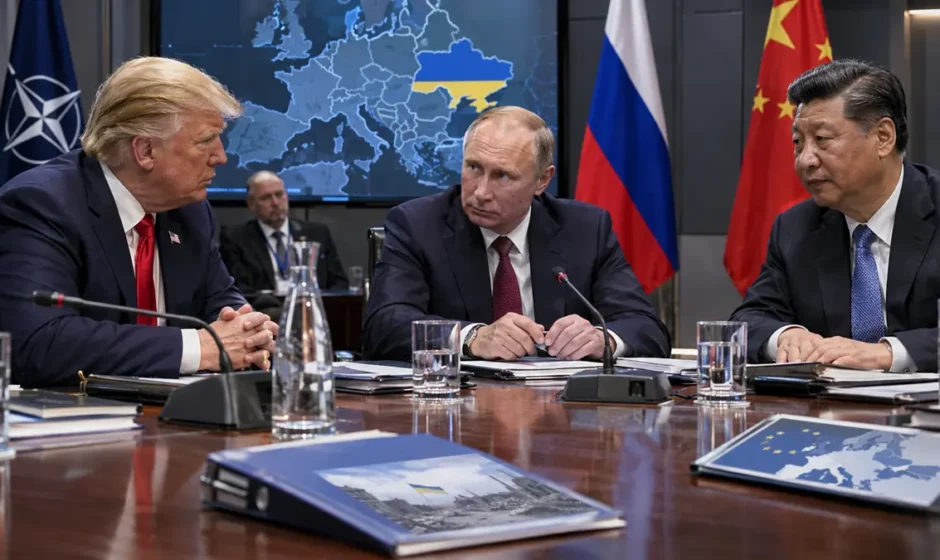
The Trump Putin Xi summit concluded in Shenzhen, China, on 19 November 2026, with the leaders of the United States, Russia and China agreeing to continue dialogue on nuclear risks, pursue UN reform and support stable energy supplies. However, their four-point declaration did not announce a peace agreement for Ukraine, leaving major questions about European security unresolved.
Donald Trump, Vladimir Putin and Xi Jinping held their first formal three-way meeting at Kylin Villa on the sidelines of the APEC gathering. Their declaration also addressed the role of international courts. Although Ukraine was discussed in diplomatic exchanges, the published document contained no settlement terms for the war.
Key Takeaways
- Trump, Putin and Xi held their first trilateral summit in Shenzhen on 19 November 2026.
- The leaders issued a four-point declaration covering UN reform, refined petroleum supplies, international courts and nuclear risks.
- They agreed to continue dialogue on reducing nuclear risks, but did not announce a binding nuclear arms reduction treaty.
- The declaration contained no Ukraine peace settlement or specific terms for ending the war.
- The meeting took place alongside the APEC gathering in China.
- The absence of a Ukraine agreement leaves questions about European security and future negotiations unresolved.
What Happened at the Trump Putin Xi Summit?
Trump, Putin and Xi Gather in Shenzhen
Donald Trump, Vladimir Putin and Xi Jinping held their first trilateral summit at Kylin Villa in Shenzhen on 19 November 2026, during the Asia-Pacific Economic Cooperation gathering.
The meeting brought together the leaders of three major nuclear powers for discussions about international security, economic cooperation and diplomatic relations.
The meeting lasted approximately 80 minutes, according to Anadolu Agency’s account of the proceedings. Reuters also reported that Trump met Putin and Xi separately during the gathering, with Ukraine among the issues raised in diplomatic discussions.
Following the Trump Putin Xi China meeting, the three governments issued a declaration addressing four areas of cooperation. However, the document did not include a peace settlement for Ukraine.
What Has Been Officially Confirmed?
A four-point declaration released by Chinese and Russian authorities after the summit sets out positions attributed to the leaders of the United States, Russia and China. It covers United Nations reform, energy supplies, international courts and nuclear security.
The first concerns reforming the United Nations to improve its response to international challenges. The second addresses increasing production and supplies of refined petroleum products to support stable energy flows.
The third concerns state consent, the immunity of government officials and the jurisdiction of the International Criminal Court. The fourth commits the three countries to dialogue on reducing nuclear risks and preventing the spread of nuclear weapons.
The declaration sets out shared positions, but it does not establish a Ukraine peace settlement or a binding nuclear disarmament treaty.
Why the Summit Did Not Produce a Ukraine Peace Agreement
What the Leaders Have Said About Ending the War
Ukraine featured in discussions surrounding the Trump Putin Xi summit, but the declaration released after the meeting did not mention the war or propose a settlement.
Putin said he discussed Ukraine during separate meetings with Trump and Xi. Trump had also identified the conflict as an important diplomatic issue ahead of the gathering.
The absence of Ukraine from the declaration means the three governments did not publicly establish common peace terms through this document.
For those following the Ukraine peace talks, the distinction is significant. The leaders discussed international security, but the published outcome offers no agreed ceasefire arrangements, territorial settlement or security guarantees for Ukraine.
What Is Still Missing From a Possible Peace Agreement?
A conversation between foreign leaders cannot, by itself, settle the future of another country.
The Shenzhen declaration does not explain how Ukraine could participate in future negotiations or whether the three governments intend to pursue a separate diplomatic process involving Kyiv. Those questions remain unanswered following the summit.
Any credible settlement would need to address difficult questions that have remained unresolved throughout the war.
- How Ukraine’s territorial sovereignty would be protected
- What security guarantees could prevent renewed attacks?
- Who would monitor and enforce a possible ceasefire?
- Whether Ukraine would accept the proposed terms
These are substantive issues rather than diplomatic formalities.
The Ukraine peace talks also involve European governments that have provided military, financial and political assistance to Kyiv. Their responsibilities would become particularly significant if an agreement required long-term security commitments.
What the China Summit Means for the UK and European Security
Britain’s Position on Ukraine Remains Unchanged
The Shenzhen discussions come as Britain continues to strengthen its relationship with Ukraine.
In a joint statement following the UK–Ukraine Strategic Dialogue held in Kyiv on 11 and 12 November, both governments reaffirmed their commitment to Ukraine’s sovereignty and security.
The UK also highlighted a £10.5 billion support package covering economic resilience, export finance and assistance with winter air defence.
On 17 November, the British government announced further winter support worth £240 million, including more than 1,000 air defence missiles.
These commitments provide useful context for understanding the European security concerns surrounding the summit.
Britain’s policy remains focused on helping Ukraine defend its territory and critical infrastructure. Those commitments remain separate from the declaration issued after the Shenzhen summit.
The summit’s declaration did not address Ukraine’s sovereignty or outline security guarantees for the country. Britain’s existing commitments therefore remain a separate part of the international response to the war, rather than an agreement reached in Shenzhen.
European Leaders Pursue Their Own Diplomatic Priorities
European governments must consider how any future agreement would affect the continent’s security.
The issues extend beyond the fighting in Ukraine. They include military deterrence, NATO cooperation, sanctions and the credibility of international commitments.
For the UK, European security concerns are closely connected to the possibility of renewed Russian military pressure if a ceasefire lacks effective safeguards.
Diplomatic discussions may create opportunities for progress, but European governments would still need to assess the details of any proposal.
The UK support for Ukraine policy also gives Britain a practical interest in how future security arrangements are negotiated and implemented.
The declaration’s reference to international courts also has implications for European discussions about accountability. It emphasises the immunity of state officials and questions the exercise of jurisdiction by the International Criminal Court, an institution whose authority has been contested by Russia. European governments may assess this position alongside the summit’s wider diplomatic outcome.
What Did the Leaders Agree on Nuclear Arms Control?
Three Leaders Commit to Dialogue on Nuclear Risks
Nuclear arms control emerged as one of the confirmed areas of cooperation following the Trump Putin Xi China meeting.
The three leaders agreed to conduct dialogue aimed at reducing nuclear risks and preventing the proliferation of nuclear weapons.
Their declaration also reaffirmed the principle that nuclear war must never be fought.
However, the document does not specify weapons reduction targets, verification arrangements or a timetable for negotiating a binding treaty.
The outcome represents a commitment to further discussions rather than an agreement to reduce existing nuclear arsenals.
Why a Three-Way Agreement Remains Uncertain
The United States and Russia have historically maintained much larger nuclear arsenals than China.
That difference has complicated previous proposals to bring Beijing into the same arms control framework.
China has expressed reservations about participating in trilateral negotiations under conditions it regards as unequal.
Even if leaders agree that reducing nuclear risks is desirable, they may have different expectations about what negotiations should cover.
The Shenzhen declaration establishes a shared commitment to dialogue, but it leaves unresolved how future negotiations would address differences in arsenal sizes, verification and national security priorities. Whether those discussions produce a formal agreement remains uncertain.
Why China Is Hosting the Talks During APEC
Shenzhen’s Role in China’s Diplomatic Strategy
The APEC summit China is hosting brings together representatives of 21 Asia-Pacific economies.
Unlike a military alliance, APEC primarily promotes economic cooperation, trade and investment. Its members include countries with significantly different political systems and foreign policy interests.
China has identified openness, innovation and cooperation as priorities for its 2026 hosting year.
Shenzhen offers a setting closely associated with technology, manufacturing and international commerce.
By hosting the trilateral meeting alongside APEC, China provided a venue for discussions extending beyond the forum’s formal economic agenda. The resulting declaration addressed international security, energy supplies and institutional reform.
How Trade and Security Agendas Overlap
Trade disputes, sanctions and access to technology often influence relationships between major powers.
The Trump Putin Xi China meeting therefore takes place against a wider background of US-China economic competition, Russian sanctions and concerns about global stability.
However, the economic objectives of APEC should not be confused with the separate diplomatic interests of the three governments.
Energy cooperation became one of the summit’s concrete discussion areas. The declaration expresses support for increasing refined petroleum production and supplies, although it does not identify individual projects, production targets or implementation deadlines.
What Happens Next After the Trump Putin Xi Summit?
The Announcements That Will Matter Most
The declaration gives an initial account of the summit’s outcome, but several practical questions remain unanswered.
Future developments worth monitoring include
- Whether the three governments establish a formal nuclear risk dialogue
- Whether specific United Nations reform proposals emerge
- Whether energy cooperation produces measurable supply commitments
- Whether separate negotiations involving Ukraine are announced
- How European governments respond to the declaration’s position on international courts
These developments will help determine whether the summit produces concrete policy changes beyond its initial diplomatic statement.
What Remains Unconfirmed
The Trump Putin Xi summit ended without a publicly announced Ukraine peace agreement or binding nuclear weapons reduction treaty.
The declaration does not provide detailed implementation arrangements for its commitments on UN reform, refined petroleum supplies or nuclear risk dialogue.
Although the meeting created a new opportunity for diplomatic engagement, the practical consequences remain uncertain. Further official announcements will be needed to establish whether its commitments lead to negotiations or policy changes.
Conclusion
The Trump Putin Xi summit concluded on 19 November with a four-point declaration covering international institutions, energy supplies and nuclear risks.
However, the absence of a Ukraine settlement leaves important questions about European security unanswered. The agreement to continue nuclear dialogue also falls short of a formal disarmament treaty.
For Britain and its European partners, the next developments will be the practical steps taken by the three governments and any separate negotiations involving Ukraine.
For further verified developments on international politics, Ukraine and European security, follow The Global Critique’s latest Politics coverage.