

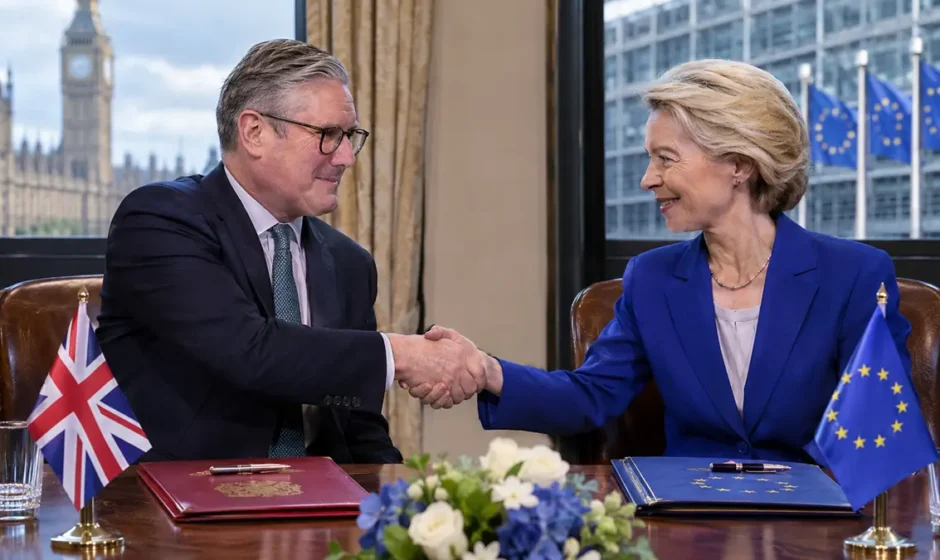
The UK EU Brexit reset deal agreed in Brussels on 20 November 2026 will ease food trade barriers, link carbon markets and create new opportunities for young people to work, study and travel across Europe. Prime Minister Andy Burnham reached the agreements with European Commission President Ursula von der Leyen and European Council President António Costa. However, most practical changes will take effect later, while negotiations over university tuition fees remain unfinished.
The UK EU summit marks a significant step in rebuilding relations after Brexit. The government estimates the package could add up to £17 billion annually to the British economy by 2040, although that forecast depends on successful implementation.
Key Takeaways From the UK EU Brexit Reset Deal
- Britain and the EU agreed measures to reduce paperwork and checks on food and agricultural exports.
- Carbon market cooperation is designed to protect industries including steel and aluminium from additional border charges.
- The youth mobility arrangement will offer eligible 18 to 31-year-olds temporary opportunities abroad.
- New food trade arrangements are expected from March 2028, with other measures following separate timetables.
- A dispute over student tuition fees remains unresolved, despite progress elsewhere.
- EU governments are considering a proposal to include British-built electric vehicles in the Made in Europe scheme, but the terms remain under negotiation.
What Did Britain and the EU Agree in Brussels?
Three Agreements and a Remaining Dispute
The second UK-EU summit brought together Burnham, von der Leyen and Costa to discuss economic cooperation, mobility and European security.
According to the official EU-UK summit joint statement, both sides committed to closer relations while continuing negotiations on outstanding issues.
The central agreements cover food and plant safety requirements, emissions trading systems and a reciprocal Youth Experience Scheme.
Why the Deal Matters Beyond Brexit Politics
The arrangements seek to remove specific obstacles created by Britain’s departure from the EU without restoring membership of the bloc, its customs union or unrestricted freedom of movement.
That distinction matters for businesses looking for easier access to European customers and individuals hoping for new opportunities abroad.
The agreements also involve obligations, including alignment with relevant EU food safety rules. Their commercial value will depend on implementation, not the announcement alone.
How the UK EU Food Trade Agreement Could Affect Businesses
Export Certificates, Border Checks and Food Costs
The UK EU food trade agreement targets paperwork and inspections affecting agricultural goods moving across borders.
Under current arrangements, exporters can face health certification requirements and other administrative costs when sending products such as meat, dairy goods, plants and seeds into European markets.
The UK government’s 20 November announcement says export health certificates can cost up to £200 each. Removing many of these requirements could reduce delays and expenses.
For a British producer shipping fresh food, faster customs procedures could mean fewer administrative charges and less risk of products deteriorating before delivery.
When Will the New Food Trade Rules Begin?
The UK EU food trade agreement is expected to take effect in March 2028, according to Reuters’ breakdown of the summit agreements.
Britain will need to follow relevant EU food and plant safety regulations as part of the arrangement.
The government estimates the UK EU food trade agreement could add up to £5.1 billion annually to the economy by 2040. This is a projected benefit, not a saving already achieved.
Consumers might eventually benefit from reduced supply costs, but lower supermarket prices are not guaranteed.
What the UK EU Carbon Trading Agreement Means for Industry
Why Steel and Aluminium Exporters Could Benefit
The UK EU carbon trading agreement would connect the two emissions trading systems.
These systems require businesses in covered sectors to account for their greenhouse gas emissions through tradable allowances.
Closer coordination could help British manufacturers avoid additional charges under the EU’s Carbon Border Adjustment Mechanism, which places a carbon-related cost on certain imported products.
The government says approximately £6.5 billion of British exports, including steel and aluminium, could be protected from those charges.
It estimates the UK EU carbon trading agreement could contribute up to £3.8 billion annually to the UK economy by 2040.
Those figures measure different things. The export value should not be added to the estimated annual economic benefit.
When Will Carbon Market Linking Start?
Implementation of the UK EU carbon trading agreement is expected in 2028.
Businesses will need further technical details before they can establish precisely how emissions allowances and cross-border obligations will operate.
The potential benefits may also vary between industries.
When Will the UK EU Youth Mobility Scheme Open?
Who Will Qualify Under the Agreed Scheme?
The UK EU youth mobility scheme, formally described as the Youth Experience Scheme, will allow eligible young people to spend up to three years working, studying or travelling across participating countries.
The main announced conditions include
- An age range of 18 to 31
- Temporary stays lasting up to three years
- Reciprocal opportunities for British and EU participants
- An annual cap of 100,000 participants
- Visa-based participation without automatic access to benefits or the right to bring dependants
The government says participants will not need an advance job offer or meet salary or language requirements.
Why Young People Cannot Apply Immediately
The UK EU youth mobility scheme is expected to become operational by January 2030.
Although the main terms have been announced, detailed application procedures have not yet been finalised.
Young people should therefore avoid treating the agreement as an immediately available immigration route.
The UK EU youth mobility scheme also differs from full freedom of movement because participation is limited by age, duration and visa conditions.
For more context, Burnham’s position on UK EU freedom of movement explains the separate political debate surrounding broader immigration rights.
Why EU Student Tuition Fees Remain Unresolved
The Disagreement Over University Fees
Negotiations over EU student tuition fees remained unfinished when the Brussels summit concluded.
Following Brexit, many European students attending British universities have faced international tuition rates rather than the lower fees available to eligible domestic students.
European governments have sought more favourable arrangements, while Britain has not agreed to a new fee structure.
The dispute has become one of the remaining obstacles in the wider relationship.
The Six-Month Negotiating Deadline
The official summit statement commits both sides to completing negotiations on a supplementary agreement covering EU student tuition fees within six months of 20 November.
That timetable is an objective rather than confirmation that lower fees will be introduced.
Until new rules are announced, prospective students should rely on existing university and government guidance when planning their finances.
Can the Brexit Reset Deliver the Promised Economic Benefits?
What the Government’s £17 Billion Estimate Means
The government estimates that the overall package could raise UK economic output by up to 0.5% by 2040, equivalent to approximately £17 billion annually.
That figure represents a forecast of future economic activity. It is not an immediate government payment or a guaranteed reduction in household bills.
The wider UK EU Brexit reset deal could improve trading conditions, but the eventual results will depend on business investment, regulatory arrangements and how quickly the measures take effect.
What Remains Uncertain
British businesses still need clarity on implementation costs, applicable rules and the practical operation of the agreements.
Negotiations also continue over electricity market cooperation and other unresolved parts of the UK-EU relationship.
Government projections provide a benchmark, but actual export performance, investment and consumer prices will offer stronger evidence over time.
What Happens Next After the UK EU Summit?
The UK EU summit established several milestones rather than one immediate implementation date.
| Measure | Expected timing |
| Student tuition fee negotiations | Within six months of 20 November 2026 |
| Food trade arrangements | March 2028 |
| Emissions trading linkage | 2028 |
| Youth Experience Scheme | By January 2030 |
These are reported targets, and practical arrangements remain subject to the necessary implementation steps.
Could British Electric Vehicles Qualify for Made in Europe?
British-built electric vehicles could qualify for the European Union’s proposed Made in Europe scheme under a compromise being discussed by EU member states.
Reuters reported on 24 November that Ireland, which holds the rotating presidency of the Council of the EU, had circulated a proposal that could allow British vehicles to count as European-made for certain industrial support and procurement rules.
The proposal matters because British manufacturers rely heavily on European suppliers and customers. Exclusion from the scheme could weaken their competitive position in the European automotive market.
However, no final agreement has been reached. The conditions for participation, including possible reciprocal trade requirements, remain under discussion.
EU industry ministers are expected to discuss the issue on 3 December 2026. A common position and negotiations with the European Parliament would still be required before any final rules could take effect.
Conclusion
The UK EU Brexit reset deal has produced substantive agreements on trade, industrial emissions and opportunities for younger people, but its economic impact will emerge gradually.
The unresolved student fee dispute and lengthy implementation timetable show why the Brussels announcement is a beginning rather than a finished settlement.
Follow The Global Critique for verified updates on the agreements, their implementation and their effects on British businesses and households.