

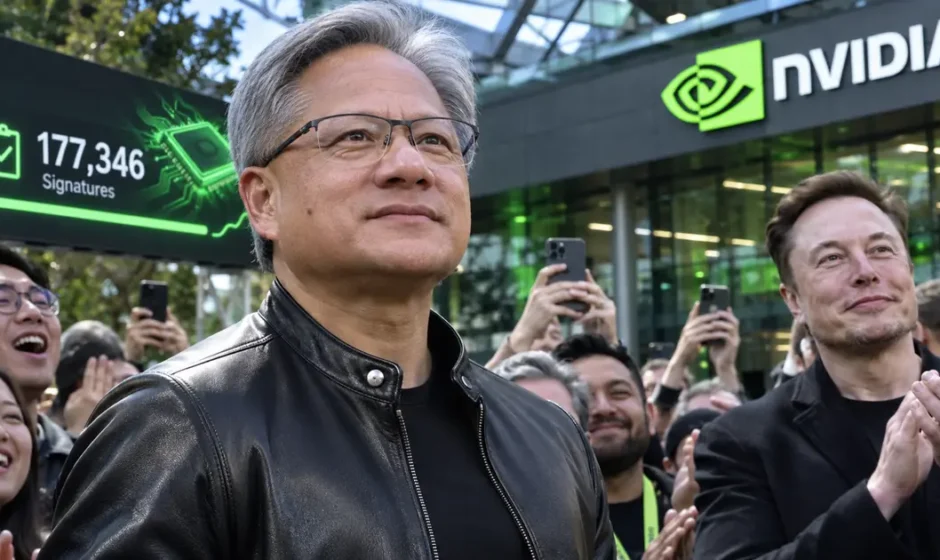
Update, 23 November 2026. Nvidia has officially reinstated Jensen Huang as president, chief executive officer and a member of its board. The decision follows a public campaign for his return that attracted more than 177,000 signatures by 16 November, with support from Elon Musk and other technology leaders. Nvidia’s announcement confirms Huang’s return but does not establish that the petition alone caused the board’s decision. An independent investigation remains ongoing.
Update, 17 November 2026: Jensen Huang has said he would be honoured to return as Nvidia CEO if the board agrees, in his first public statement since resigning. Read our latest report: Nvidia reinstates Jensen Huang as CEO after board vote. This article has also been updated with Nvidia’s third-quarter results.
Elon Musk and prominent technology executives backed the Jensen Huang Nvidia return campaign after a petition calling for the former chief executive’s reinstatement gained more than 177,000 signatures by 16 November. Reuters reported the campaign following Huang’s resignation on 12 November. Nvidia initially appointed Colette Kress as interim CEO, but the board subsequently reversed course and restored Huang to his leadership position.
The campaign placed Nvidia’s leadership decisions under intense scrutiny during a period of uncertainty. Huang’s reinstatement has resolved the immediate CEO succession issue, but the independent investigation continues. Shareholders and technology customers will now be watching how Nvidia maintains confidence in its governance and operations.
Key Takeaways
- Nvidia confirmed Jensen Huang’s reinstatement as CEO on 23 November.
- The return petition had attracted more than 177,000 signatures by 16 November.
- Elon Musk, Amjad Masad and Tim Sweeney were among the campaign’s reported supporters.
- Colette Kress served as interim CEO following Huang’s resignation and continues as CFO.
- The board’s decision followed the campaign, but Nvidia has not established the petition as its sole cause.
- The independent board investigation remains ongoing.
Why Did Jensen Huang Leave Nvidia?
Nvidia Confirms the CEO Resignation
The Nvidia CEO resignation became public on 12 November, when the chipmaker announced that Huang had stepped down as president, chief executive and board member.
A filing with the US Securities and Exchange Commission shows directors accepted his resignation on 11 November, effective immediately.
Huang co-founded Nvidia in 1993 and spent more than three decades shaping its development. His leadership helped transform a graphics-chip company into a major supplier of computing systems used for artificial intelligence.
The sudden departure therefore raised questions well beyond the identity of his successor.
What Is Confirmed About the Investigation?
The Nvidia board investigation began after reports raised concerns about Huang’s personal relationships, including an alleged connection involving a woman suspected of working for Chinese intelligence.
These allegations have not been established as findings of misconduct or espionage. They must be distinguished from Nvidia’s confirmed leadership announcement.
In its statement on 8 November, the board said it had no reason at that stage to believe national security or company secrets had been compromised.
The inquiry is examining available information, and its eventual findings could influence how directors explain their decisions.
Who Is Behind the Jensen Huang Return Petition?
Elon Musk and Technology Executives Join the Campaign
The Elon Musk Jensen Huang petition campaign, called Stand With Jensen, has attracted attention across Silicon Valley.
Reuters reported that Tesla and SpaceX chief Elon Musk was among its supporters, alongside Replit CEO Amjad Masad and Epic Games CEO Tim Sweeney.
Their involvement has brought greater public visibility to the campaign, although none of these executives has the authority to appoint Nvidia’s chief executive.
Supporters argued that Huang deserved a fair process before directors made a permanent leadership decision.
The campaign also reflects concerns among some employees, investors and business partners about losing a leader closely associated with Nvidia’s strategy.
What Do More Than 177,000 Signatures Mean?
The petition website allows supporters to identify their connections with Nvidia, but those affiliations have not been independently verified. Its signature total should therefore be understood as the campaign’s reported count rather than an independently audited record of employee or shareholder support.
According to Reuters reporting on 16 November, the campaign had collected more than 177,000 signatures.
The Elon Musk Jensen Huang petition therefore represents substantial public support, but signatures do not amount to a binding shareholder vote.
People signing may include employees, shareholders and members of the public. Their legal influence differs considerably.
The Jensen Huang Nvidia return movement increased public pressure on directors to explain their decisions, although the petition did not legally oblige the board to reverse the resignation.
That distinction matters as online support grows faster than formal corporate decision-making.
How Nvidia’s Board Reinstated Jensen Huang
Investors Urge Directors Not to Rush
The campaign has been accompanied by an open letter involving investors Gavin Baker of Atreides Management and Brad Gerstner of Altimeter Capital.
Both urged Nvidia’s directors not to rush into a permanent appointment before the relevant facts had been established.
The letter argued that Jensen Huang reinstatement deserves consideration while the investigation continues.
That position was a request from investors and campaign supporters, not evidence that the board has accepted their argument.
Who Controls the CEO Appointment?
Nvidia’s directors are responsible for selecting the company’s chief executive and overseeing management.
They must consider the company’s interests, relevant evidence, legal advice and obligations to shareholders.
Nvidia’s board has now exercised its authority to reinstate Huang as chief executive. The company confirmed his return on 23 November following a unanimous board decision. Directors said they were satisfied that his leadership was in Nvidia’s best interests. The announcement resolved the immediate CEO succession question, although the independent investigation and related governance oversight continue.
Colette Kress Returns to CFO Role After Interim Leadership
Colette Kress Led Nvidia During the CEO Transition
Colette Kress interim CEO arrangements were announced alongside Huang’s departure.
Kress joined Nvidia in September 2013 as chief financial officer after holding senior financial positions at Cisco and Microsoft.
Colette Kress served as interim chief executive following Huang’s departure. After his reinstatement, she continues as Nvidia’s chief financial officer. Her interim leadership helped the company navigate a period of uncertainty, including the release of its third-quarter financial results.
Nvidia also appointed longtime director Harvey C. Jones as its first board chair.
The company says its experienced management team remains capable of maintaining business operations and commitments.
What Does the Leadership Change Mean for Operations?
Colette Kress’s appointment as interim CEO provided Nvidia with an experienced executive during its leadership transition. Her responsibilities included maintaining investor confidence, overseeing operational priorities and communicating financial results. Following Huang’s reinstatement, she continues as chief financial officer.
Still, financial expertise does not remove every challenge created by a sudden leadership transition.
The Nvidia CEO resignation initially left directors balancing business continuity against a difficult public debate about corporate governance. Huang’s reinstatement has resolved the immediate leadership uncertainty.
Customers will want reassurance that product deliveries, technical support and development plans remain on schedule.
How Is the Leadership Crisis Affecting Nvidia Investors?
What Has Happened to Nvidia’s Market Value?
The Nvidia stock impact has become an important part of the story.
Reuters reported on 16 November that Nvidia’s market valuation had fallen to approximately $3.9 trillion from around $5.8 trillion before the recent decline. The comparison reflects a substantial change in investor sentiment, but the full movement should not be attributed solely to Huang’s resignation.
Questions about AI spending, profitability and future growth also influence the company’s share price.
Investors should distinguish confirmed trading figures from predictions about where Nvidia shares might move next.
Why the CEO Decision Matters to Shareholders
The Nvidia leadership crisis raises what investors sometimes call key-person risk.
This describes the uncertainty a business faces when a particularly influential executive leaves.
Huang was closely involved in Nvidia’s strategy, product announcements and relationships across the technology industry.
However, the company also has established engineering teams, senior executives and commercial commitments.
The Nvidia stock impact will depend partly on whether investors believe Nvidia can maintain operational stability and growth following Huang’s reinstatement.
A leadership change alone does not determine future earnings, product demand or shareholder returns.
Why the Nvidia Shake-Up Matters to the AI Industry
Nvidia’s Role in AI Infrastructure
Nvidia supplies graphics processing units, computing platforms and software used by technology companies to develop and operate artificial intelligence systems.
Its products underpin major data centres and provide computing capacity for increasingly complex AI applications.
This position makes its corporate decisions important to customers, suppliers and investors across the global technology market.
The Nvidia leadership crisis therefore reaches beyond one company’s boardroom.
What Customers and Partners Could Be Watching
Companies purchasing Nvidia technology are likely to focus on product delivery, research priorities and long-term supply arrangements.
The board has expressed confidence that its operations and development roadmap will continue without interruption.
That assurance is significant, although future performance will depend on execution.
For the wider AI chip industry, the transition also raises questions about competition, investment decisions and the relationships that helped Nvidia expand.
Customers may seek clearer communication, but there is no confirmed evidence that the resignation has stopped production or cancelled existing supply commitments.
What Is Known About the Nvidia Board Investigation?
Independent Review and Outstanding Questions
The Nvidia board investigation is being conducted with outside legal assistance.
On 10 November, independent directors confirmed that former acting US Attorney Joon H. Kim and the law firm Wachtell, Lipton, Rosen & Katz had been retained to conduct the review.
Nvidia has not publicly announced a completed investigation or final findings establishing that company information was compromised.
This distinction is particularly important because speculation surrounding personal relationships and national security can damage reputations before evidence is assessed.
Responsible reporting should identify what is confirmed rather than treat every allegation as a conclusion.
Why the Investigation Matters to the CEO Decision
Although Nvidia has reinstated Huang, the independent investigation has not concluded. Its findings could still affect the company’s governance policies, compliance oversight and future disclosures. The leadership decision and the outcome of the investigation should therefore be treated as separate developments.
Nvidia’s board has already resolved the immediate leadership question by reinstating Huang. However, the findings of the independent review may still shape future compliance procedures, corporate governance safeguards and the company’s response to outstanding concerns.
What Happens Next for Nvidia and Jensen Huang?
Nvidia’s Third-Quarter Results
Nvidia reported revenue of $115.8bn for the third quarter of fiscal 2027, which ended on 25 October, up 20% from the previous quarter and 103% from a year earlier, according to the company’s results release. Data centre revenue was $107.6bn, up 110% year on year.
They were the company’s first quarterly results since Huang’s departure. Interim chief executive Colette Kress said: “Our momentum is real.” The release referred to the leadership transition, the search for a new chief executive and an ongoing investigation by an independent committee of the board.
Nvidia said it expects fourth-quarter revenue of $130bn, plus or minus 3%. That figure is company guidance, not a reported result.
Three Developments Investors Should Watch
Several developments could clarify the company’s direction.
- Further official disclosures from Nvidia’s independent investigation
- Changes to corporate governance, national security and export control oversight
- Nvidia’s financial performance and market response following Huang’s reinstatement
The Nvidia stock impact may also become clearer as investors assess earnings and management’s response.
The Jensen Huang Nvidia return campaign has achieved the outcome its supporters demanded, although the extent to which the petition influenced the board’s decision has not been established. Attention now turns to the continuing investigation, governance safeguards and Nvidia’s performance under Huang’s restored leadership.
Conclusion
The campaign calling for Jensen Huang’s return drew widespread attention from Silicon Valley executives, investors and Nvidia supporters. His reinstatement on 23 November has now resolved the immediate question of who will lead the company.
However, the board’s decision does not establish that public pressure alone determined the outcome. Nvidia still faces questions about corporate governance, compliance and the continuing independent investigation.
The focus now shifts from whether Huang will return to how Nvidia will manage those outstanding issues while maintaining confidence among shareholders, employees and customers.
For verified developments on Nvidia, the AI industry and major corporate decisions, follow The Global Critique’s latest business coverage.