


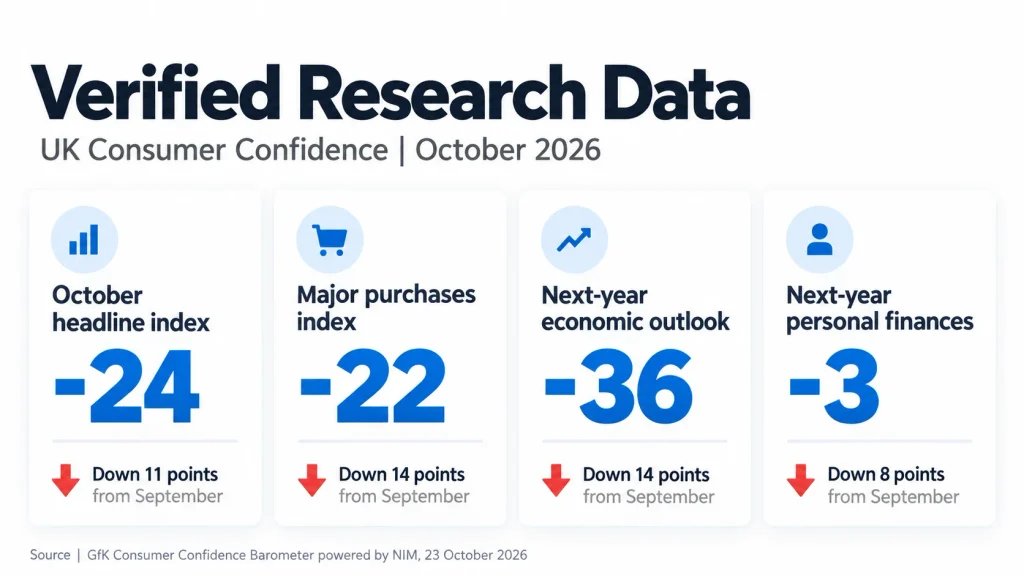
UK consumer confidence suffered its sharpest monthly decline since the early Covid pandemic, falling 11 points to -24 in October 2026, according to figures published on 23 October. The latest GfK Consumer Confidence Barometer powered by NIM shows that households have become more pessimistic about their finances, the wider economy and making expensive purchases. The survey was conducted between 1 and 14 October, before the UK Budget on 28 October 2026. Its findings provide a snapshot of household concerns before the announcement and cannot show how consumers have responded to the measures introduced in the 28 October Budget. Subsequent confidence surveys will provide a clearer indication of any change in household expectations.
The decline reverses the improvement in sentiment seen during the summer and raises questions about whether consumers will reduce discretionary spending in the months ahead.
However, the latest economic evidence presents a more complicated picture than the headline suggests. Retail sales weakened in September, while a separate business survey showed stronger private-sector activity in October.
For families, retailers and policymakers, understanding that difference is essential to assessing what the confidence figures actually mean.
Key Takeaways From the October Consumer Confidence Report
- The headline consumer confidence index fell from -13 in September to -24 in October, a decline of 11 points.
- All five components contributing to the overall index weakened.
- Expectations for the UK economy over the next year fell 14 points to -36.
- The Major Purchase Index also dropped 14 points, reaching -22.
- Expectations for personal finances over the next 12 months declined eight points to -3.
- The separate Savings Index increased one point to +28.
- The GfK consumer confidence index recorded its largest monthly fall since April 2020.
- The October confidence survey was completed before the 28 October 2026 Budget and therefore cannot measure household reactions to the measures announced.
- Retail figures released on 10 November showed UK sales rising 1.5% year on year in October, while separate Barclays data recorded 2.3% growth in consumer card spending. Both suggest spending remained resilient despite weaker household confidence.
The survey provides an early warning about household sentiment, although it does not establish that consumer spending will fall by the same amount.
Why UK Consumer Confidence Has Fallen So Sharply
The October survey points to a broad deterioration in public expectations rather than a sudden change in one particular measure.
Households have become more concerned about their financial position and the direction of the national economy. Those concerns emerged amid rising prices and international pressures on energy costs, as the government prepared for its 28 October Budget.
Persistent Living Costs Are Squeezing Household Budgets
The latest UK cost of living pressures have been reinforced by renewed inflation.
Official figures released on 21 October show that annual Consumer Prices Index inflation increased to 3.5% in September, up from 3.1% in August.
Transport costs, particularly motor fuels, made the largest upward contribution to the annual inflation rate.
The Consumer Prices Index including owner occupiers’ housing costs, known as CPIH, also rose to 3.6%.
These figures indicate that the overall price level was still increasing, even though the experience of individual households depends on their spending patterns.
Higher fuel, energy and other essential expenses can leave families with less financial flexibility, especially when wages or other income fail to keep pace.
The latest UK inflation figures provide useful context for the weakening sentiment.
Economic Uncertainty Has Replaced Summer Optimism
September’s confidence reading of -13 had been the strongest since August 2024.
By October, that improvement had disappeared.
Neil Bellamy, Consumer Insights Director at GfK, attributed the deterioration to a combination of financial pressures and international uncertainty rather than one isolated economic event.
The survey also found weakening sentiment across income, age and gender groups.
This suggests that the decline was not confined to one small section of the population.
For readers examining UK consumer confidence in October 2026, the important development is therefore the speed and breadth of the reversal.
The survey does not prove that every household became financially worse off during October. Instead, it shows that respondents’ assessments and expectations shifted in a more negative direction.
What the GfK Consumer Confidence Index of -24 Actually Means
The GfK consumer confidence index measures how people feel about their financial circumstances and the economic outlook.
A reading of -24 indicates negative overall sentiment on the survey’s index scale.
It does not mean that household spending has fallen by 24%, that prices have increased by 24%, or that exactly 24% of respondents are pessimistic.
How the GfK Confidence Score Is Calculated
The monthly survey asks people about five principal areas.
- Their household finances over the previous 12 months
- Their expectations for household finances over the next 12 months
- Their assessment of the national economy over the previous 12 months
- Their expectations for the national economy over the next 12 months
- Whether they believe it is a suitable time to make major purchases
GfK combines these responses into its headline index.
A separate savings measure is reported alongside the main results but does not contribute to the overall confidence score.
This distinction helps explain why the Savings Index could increase slightly even as overall confidence fell sharply.
Why an 11-Point Monthly Fall Matters
The October decline is significant because of its size compared with previous monthly changes.
In April 2020, during the initial coronavirus restrictions, the confidence index fell 25 points.
The last comparable 11-point decline outside that period occurred in July 2016, following the Brexit referendum.
October’s fall therefore represents an unusually rapid deterioration in sentiment, although the index has reached lower absolute levels at other points in its history.
The research was conducted among 2,003 UK residents aged 16 and over between 1 and 14 October 2026.
GfK uses quotas covering age, sex, region and social class, and reports an estimated survey margin of error of approximately 2%.
The UK consumer confidence October 2026 findings consequently provide a substantial national snapshot, but they remain survey estimates rather than a direct measurement of every household’s finances.
Which Parts of Household Confidence Have Deteriorated Most
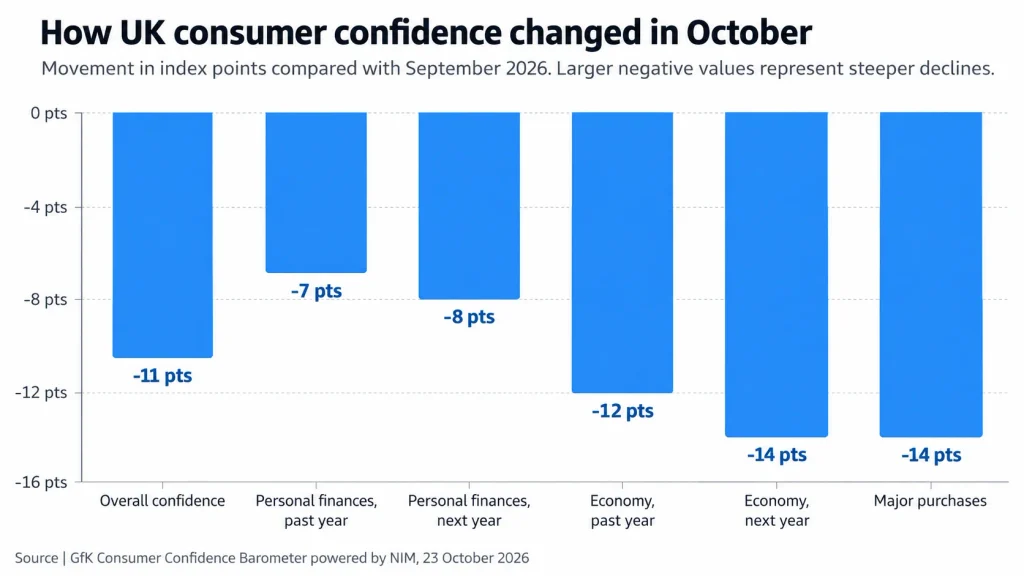
The latest data show that expectations about the wider economy and willingness to spend on major purchases recorded the largest monthly declines.
The GfK consumer confidence index breakdown helps identify which concerns are driving the headline result.
| Confidence measure | September | October | Change |
| Overall consumer confidence | -13 | -24 | -11 |
| Personal finances over past year | -3 | -10 | -7 |
| Personal finances over next year | +5 | -3 | -8 |
| UK economy over past year | -36 | -48 | -12 |
| UK economy over next year | -22 | -36 | -14 |
| Major purchases | -8 | -22 | -14 |
| Separate Savings Index | +27 | +28 | +1 |
Source – GfK Consumer Confidence Barometer powered by NIM, 23 October 2026.
Expectations for the UK Economy Have Weakened
The measure assessing the economy over the previous year fell 12 points to -48.
More significantly for future expectations, the index measuring the next 12 months declined 14 points to -36.
This shows that respondents were concerned not only about recent economic conditions but also about what could happen during the year ahead.
Such expectations matter because households may adjust financial decisions when they feel uncertain about employment, borrowing costs or their future purchasing power.
However, weaker expectations do not establish that economic conditions will necessarily deteriorate.
Households Are Less Confident About Their Own Finances
The assessment of household finances over the previous year declined seven points to -10.
Expectations for the coming year fell eight points to -3, moving from a positive reading in September.
That change is particularly relevant to the UK household spending outlook because confidence in future finances can influence decisions about saving, borrowing and making larger purchases.
A household that feels uncertain about its future income may decide to preserve cash even if its current earnings have not changed.
The survey captures those expectations but does not show how much money individual respondents actually have available.
Willingness to Make Major Purchases Has Declined
The Major Purchase Index fell to -22, its lowest reading in more than two years.
This part of the survey examines whether consumers think the current economic environment is favourable for buying expensive items.
Furniture and electrical goods are examples used in the research.
A weaker reading suggests that more respondents view the timing of such purchases negatively.
It does not mean that sales of household appliances or furniture have already fallen by 14%.
The distinction matters for businesses because consumer intentions can be an early signal without being a guaranteed forecast of future sales.
How Rising Costs Are Affecting Everyday Spending Decisions
Economic confidence often changes before visible adjustments emerge in household purchasing data.
When essential spending takes a larger share of income, families may become more selective about how they use the money that remains.
Energy, Fuel and Essential Expenses
Persistent UK cost of living pressures can affect households in several ways.
Higher transport costs increase the expense of commuting and routine travel.
Energy bills can make monthly budgeting less predictable, particularly when households anticipate further increases.
Food, housing and other essential costs may also limit flexibility, although individual circumstances differ considerably.
Consumers with substantial savings or rising earnings may respond differently from those already struggling to meet regular payments.
The national index cannot capture every one of those experiences.
Wholesale Gas Prices Rise Ahead of Winter
European wholesale gas prices climbed to approximately €97 per megawatt-hour on 26 October 2026, while the UK’s month-ahead gas contract reached around 240 pence per therm. The increase reflected concerns about winter heating demand, European gas storage levels and possible disruption to international energy supplies.
The latest European gas market developments highlight another potential pressure on household finances as Britain approaches the colder months.
However, the timing matters. The October consumer confidence survey collected responses between 1 and 14 October, before the latest price increase. The 26 October movement therefore cannot explain the earlier 11-point decline in confidence.
Wholesale price changes also do not immediately increase regulated household energy tariffs. Ofgem’s current energy price cap applies from October to December, with the next cap announcement due by 25 November 2026.
If elevated wholesale prices persist, they could place additional pressure on future household energy costs, although the eventual impact will depend on wholesale purchasing arrangements and regulatory decisions.
Why Families May Delay Non-Essential Purchases
Households facing uncertainty may postpone decisions that involve substantial upfront spending.
Examples include replacing a working television, purchasing furniture or committing to a more expensive household improvement.
Others may compare prices more closely or avoid taking on new credit.
These are plausible responses to weaker confidence, not behaviours directly measured as completed transactions by the October survey.
The UK household spending outlook will depend on whether these attitudes persist and translate into actual purchasing decisions.
A short period of uncertainty may delay purchases without permanently eliminating them. A prolonged decline in confidence could have broader consequences for discretionary demand.
Are British Consumers Already Spending Less
Separate official retail figures suggest that spending on goods weakened in September, although the broader picture remains mixed.
The distinction between confidence and actual purchases is particularly useful when assessing UK consumer confidence alongside other economic indicators.
September Retail Sales Fell by 0.4 Percent
According to the Office for National Statistics’ September retail sales report, the volume of goods purchased in Great Britain fell by 0.4% compared with August.
This followed a revised 0.7% increase in August.
Retailers reported weaker clothing sales, partly because unusually warm September weather reduced demand for autumn and winter ranges.
Supermarket sales also declined after stronger activity during July and August.
However, sales volumes across July, August and September combined were 0.7% higher than during the preceding three months.
That quarterly improvement is important because monthly retail data can fluctuate considerably.
Why Confidence and Retail Sales Can Tell Different Stories
Consumer confidence surveys and retail sales figures measure different things.
The GfK research asks households how they feel about finances and purchasing conditions.
The ONS figures estimate the quantity of goods actually purchased through retail businesses.
These measures also cover different periods. The retail figures describe September transactions, while the confidence survey collected responses during the first half of October.
Consequently, the decline in sentiment cannot be treated as the direct cause of September’s weaker sales.
Fresh spending figures released on 10 November 2026 offer a more detailed picture of consumer behaviour, although they do not suggest that household confidence has recovered. Retail sales and card transactions remained in positive territory, while the breakdown shows shoppers continuing to exercise caution over discretionary purchases.
What October Retail Spending Revealed on 10 November 2026
Fresh retail figures published on 10 November suggest that British households continued spending in October, even as surveys pointed to rising anxiety over personal finances and the economy.
According to the British Retail Consortium’s October retail sales report, total UK retail sales increased 1.5% year on year. The result was slightly below the 1.6% growth recorded in October 2025 but stronger than the 1.2% average for the preceding three months.
The improvement was uneven. Food sales increased 3.2%, while non-food sales showed no annual growth. Spending in physical non-food stores declined 1.1%, whereas online non-food sales increased 1.8%.
That divide matters. Consumers were still buying essentials, but there was less evidence of a broad recovery in demand for furniture, household appliances and other purchases that families can postpone. The BRC said some shoppers were holding back ahead of Black Friday and Christmas promotions.
Separate Barclays consumer spending figures pointed to a more resilient overall picture. Card spending increased 2.3% year on year in October, up from 2.0% in September and the strongest annual growth since July 2025.
However, essential spending increased 3.1%, compared with growth of 1.9% in non-essential categories. The results suggest that higher expenditure does not necessarily mean households are becoming more comfortable financially, particularly when essentials are taking a larger share of their budgets.
The figures also measure different things. The BRC tracks retail sales by value, Barclays examines a wider range of card transactions, and the Office for National Statistics publishes separate inflation-adjusted retail volumes. Their percentage changes should not be treated as directly interchangeable.
For the October consumer confidence story, the distinction is significant. The 11-point fall in sentiment was a warning about household expectations, not evidence of an immediate collapse in purchases. The latest spending data show that consumer caution and modest growth can coexist.
What the Confidence Collapse Means for UK Retailers and Businesses
Retailers are particularly sensitive to changes in household expectations because many purchases can be postponed.
The implications are likely to vary between businesses selling essential products and those relying on discretionary spending.
Pressure on Retailers Selling Big-Ticket Products
The decline in the Major Purchase Index creates a potential warning for sellers of furniture, electrical appliances and other expensive household goods.
Consumers who expect their finances to weaken may hesitate before making large commitments.
Businesses might therefore face greater pressure to demonstrate value, offer competitive prices or adjust sales expectations.
Nevertheless, the survey does not establish that every retailer will experience falling revenue.
Individual business performance will also depend on employment conditions, product demand, competition and promotional activity.
Why Businesses Will Watch Christmas Spending
The October results arrive during an important planning period for Christmas retail trading.
Retailers must make decisions about stock, staffing, promotions and the timing of seasonal campaigns.
A weaker UK household spending outlook could encourage businesses to plan cautiously, especially in categories where purchases are easier to delay.
At the same time, the separate Savings Index rose from +27 to +28.
That increase does not prove that households are saving more money in practice. It indicates a slight improvement in how respondents assessed the suitability of saving.
The contrast reinforces the need to distinguish sentiment, intentions and actual spending.
For businesses, UK cost of living pressures remain an important consideration, but the strength of seasonal demand will only become clear through subsequent sales figures.
How the 28 October UK Budget Relates to Consumer Confidence
The UK Budget delivered by Chancellor John Healey on 28 October 2026 introduced measures intended to ease household energy costs and support purchasing power.
However, the October GfK Consumer Confidence Barometer was based on responses collected between 1 and 14 October. The survey therefore reflects how households felt before the Budget announcements, not their reaction to the new policies.
What the Budget Announced for Household Energy Costs
According to HM Treasury’s Budget 2026 document, the government announced a £100 Household Energy Payment for households in council tax bands A to D in England, with support scheduled to begin in January 2027.
The Budget also extended relief on domestic electricity VAT until July 2027. The government expects this measure to reduce the annual Ofgem energy price cap by around £50 in April 2027.
A separate commitment asks Ofgem to remove domestic gas standing charges in Great Britain by the end of 2027 or as soon as possible afterwards. The reform has not yet taken effect, and removing a fixed charge does not guarantee that every household will pay less overall.
These announcements may ease some cost of living pressures. However, the eventual effect will depend on eligibility, energy consumption and implementation.
Why the Budget Cannot Explain October’s Confidence Fall
The GfK headline index dropped 11 points to -24 in October, reflecting concerns recorded before the Budget.
Consequently, the £100 payment and other newly announced measures cannot explain the earlier deterioration in confidence. They also cannot yet be credited with reversing it.
The next consumer confidence survey will provide a more relevant indication of whether household expectations changed after the announcement. Even then, inflation, wages, employment and wider economic developments will need to be considered.
For retailers and businesses, the central question is whether government support eventually improves the amount households feel able to spend, particularly on non-essential purchases.
Can the UK Economy Grow While Consumer Confidence Falls
Yes. Economic activity can expand even when households report declining confidence.
This is one of the most important distinctions in the October data.
The latest surveys show that consumers and businesses are responding differently to the same economic environment.
Why Household Sentiment and Business Activity May Diverge
On 23 October, preliminary figures showed that the S&P Global UK Composite Purchasing Managers’ Index increased to 53.1 in October from 52.0 in September.
A PMI reading above 50 indicates expanding business activity, while a reading below 50 points to contraction.
October’s result suggested that private-sector activity was growing at its strongest pace since February.
Manufacturing output and services activity both strengthened, while businesses reported some improvement in hiring.
The findings also suggested that demand related to technology and artificial intelligence investment was supporting parts of the economy.
Yet the improvement did not remove concerns about rising business costs and the financial pressure facing consumers.
Household confidence reflects what individuals expect for their finances and the economy. PMI surveys examine changes reported by businesses.
They can move in different directions without contradicting each other.
What the Difference Means for Economic Forecasts
The economic outlook following the 28 October Budget cannot be assessed through one survey alone.
Consumer confidence gives an indication of sentiment. Retail sales provide evidence about purchases. PMI data offer an early assessment of business activity.
Economists also examine employment, wages, inflation and borrowing conditions.
The combination matters because economic growth can be concentrated in sectors that do not immediately improve living standards for every household.
For example, expanding demand for technology services may help business output without quickly reducing transport or grocery bills.
Readers following the latest economic figures and their impact on sterling can also see why financial markets assess several indicators together.
A stronger business survey does not invalidate consumers’ financial concerns, just as weaker consumer confidence does not establish that the entire economy is contracting.
What Happens Next for UK Consumers and the Economy
The UK Budget was delivered on 28 October 2026, followed by the Bank of England’s decision on 5 November to increase the Bank Rate from 3.75% to 4%.
The Bank said UK consumer price inflation had reached 3.5% in September and projected that inflation could approach 5% by the middle of 2027 if energy pressures persist.
These developments provide new context for the October consumer confidence survey, although they cannot explain responses collected before the announcements.
The next important evidence will come from the inflation figures due for publication in November and the next GfK consumer confidence results, both scheduled for later in November.
Key developments to monitor include
- 18 November 2026 when the next official consumer inflation figures are scheduled for publication
- 20 November 2026 when the next GfK consumer confidence results are due
- 20 November 2026 when the next ONS retail sales release is scheduled
The UK household spending outlook will depend partly on whether inflation, employment conditions and borrowing costs improve or continue putting pressure on families.
The next GfK survey will be especially useful for examining whether pessimism persists after the Budget.
Even then, one month’s recovery would not necessarily establish a lasting improvement.
What the Survey Can and Cannot Tell Us
The October findings provide a clear assessment of worsening sentiment, but the limits of the evidence matter.
The GfK consumer confidence index has tracked UK household expectations since 1974, making historical comparisons possible across different economic periods.
Its latest results establish several important developments.
What the survey confirms
- Overall household sentiment weakened considerably between September and October.
- Expectations for the wider economy deteriorated.
- Confidence in future personal finances declined.
- Respondents became less willing to make major purchases.
- The decline affected a broad range of demographic groups.
What the survey does not prove
- That the UK economy has entered a recession
- That every household has suffered a fall in income
- That retail spending has decreased by 24%
- That the 28 October Budget caused the earlier decline in October consumer confidence
- That consumer confidence will necessarily weaken again in November
The October survey reflects responses collected during the first half of the month. Events occurring after 14 October cannot explain those responses directly.
Understanding that timing helps prevent the figures from being overstated.
Conclusion
The latest UK consumer confidence figures reveal a sharp deterioration in how households view their finances and the wider economy.
The 11-point fall to -24 highlights concerns about living costs, future purchasing power and expensive purchases. However, the latest evidence points to a more complicated economic picture. Business activity showed signs of expansion, while October retail sales and consumer card spending continued to grow. The contrast suggests households have not stopped spending, but are becoming more selective about where their money goes.
The 28 October Budget and 5 November Bank of England rate increase have added important policy context to the October confidence figures. The next inflation and GfK releases will help show how household expectations are evolving, although future survey results cannot be predicted from the October decline alone.
For continued coverage of household finances, government policy and economic developments, explore The Global Critique’s latest UK business and economic news.
Frequently Asked Questions
What Is the UK Consumer Confidence Score in October 2026?
The UK consumer confidence October 2026 index stands at -24, down 11 points from September’s -13. The figures were published on 23 October by the GfK Consumer Confidence Barometer powered by NIM. The fall represents the sharpest monthly deterioration since April 2020.
What Does a GfK Confidence Score of -24 Mean?
A score of -24 indicates negative household sentiment on the survey’s index scale. It combines responses about personal finances, the economy and major purchases. It does not mean that 24% of households are pessimistic or that consumer spending has fallen by 24%.
Why Has UK Consumer Confidence Fallen So Sharply?
The October decline reflects concerns about household finances, inflation and economic uncertainty. Rising fuel prices and broader living costs provide important context. However, the researchers did not identify one single event responsible for the entire 11-point decline.
Does Lower Confidence Mean UK Households Are Spending Less?
Not necessarily. Consumer confidence measures household expectations rather than actual spending. Official figures showed UK retail sales volumes falling 0.4% in September, while separate BRC figures released on 10 November reported a 1.5% annual increase in October retail sales. Barclays also recorded 2.3% annual growth in consumer card spending. These findings suggest that weaker confidence has not translated into a broad decline in spending, although households remain cautious about discretionary purchases.
How Could the 28 October UK Budget Affect Consumer Confidence?
The Budget was delivered on 28 October 2026. Its potential effects on consumer confidence will depend on how households respond to the announced measures and wider economic conditions. The October survey was conducted before the Budget and cannot measure its impact.
When Will the Next UK Consumer Confidence Figures Be Released?
The next GfK Consumer Confidence Barometer is scheduled for 20 November 2026. It will provide an updated assessment of household sentiment following the 28 October Budget and the Bank of England’s 5 November interest rate increase.